
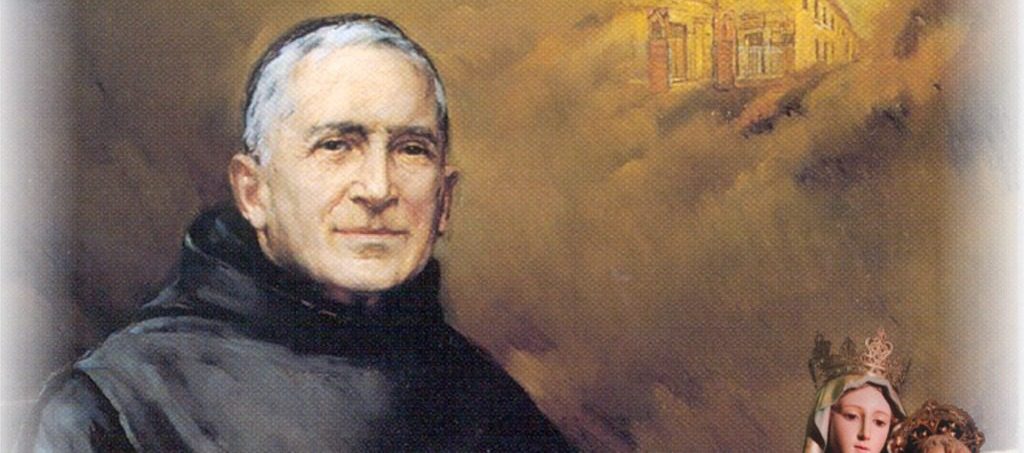
On March 11, 1841, Saint Benito Menni was born in Milan, a man whose commitment to the sick and the marginalized transformed the history of Christian hospitality. His life was marked by a deep vocation of service and love for others, which led him to restore the Hospitaller Order of Saint John of God in Spain and to found the Congregation of the Hospitaller Sisters of the Sacred Heart of Jesus on May 31, 1881.
Every March 11, our Hospitaller Family gratefully commemorates the birth of its founder and his immense contribution to the Church. His life continues to invite us to look with mercy upon those who suffer and to commit ourselves to building a more just society.
A childhood shaped by faith
Benito Menni was born into a large and deeply Christian family. His parents, Luis Menni and Luisa Figini, baptized him on the very day of his birth with the name Ángel Hércules Menni. From a young age, he showed an upright conscience and a deep sensitivity toward the suffering of others.
After completing his studies, he began working in a bank. However, at just seventeen years old, he decided to leave this job when he felt that some procedures contradicted his principles. Shortly afterward, during a spiritual retreat at the Charterhouse of Pavia, he clearly understood God’s call to dedicate his life to the service of the sick.
His hospitaller vocation
On April 19, 1860, he entered the Hospitaller Order of Saint John of God. One month later he received the religious habit and took the name Brother Benito, beginning his novitiate in Milan. He made his first vows in 1861 and, after completing his religious, priestly, and healthcare training, he was ordained a priest in Rome in 1866.
That same year he received a mission that would deeply shape his life: restoring the presence of the Order in Spain, where it had been suppressed during the nineteenth century. At only 25 years old, encouraged by Pius IX, he undertook this challenge with deep faith and extraordinary determination.
When Benito Menni arrived in Spain in 1867, the Order of Saint John of God had practically disappeared due to confiscations and the suppression of many religious communities. With patience, perseverance, and a strong apostolic spirit, he managed to rebuild the hospitaller work and reopen hospitals dedicated to caring for the most vulnerable sick.
His work was not limited to restoring structures; he also promoted a renewed vision of healthcare, especially for people with mental illness, a group deeply forgotten and marginalized at the time.
Founder of the Hospitaller Sisters
Moved by the situation of many women with mental illness and girls with disabilities, in 1881 he founded in Ciempozuelos the Congregation of the Hospitaller Sisters of the Sacred Heart of Jesus, together with María Josefa Recio and María Angustias Giménez.
Our Congregation was born with a clear mission: to offer comprehensive care to people with mental illness, always promoting their dignity, respect, and care inspired by a profound evangelical spirit.
Saint Benito Menni promoted an innovative care model for his time that sought to integrate “science and charity,” combining medical advances with humane, compassionate, and deeply Christian care.
A legacy that lives on
Throughout his life, Saint Benito Menni founded numerous hospitals, asylums, and care centers. His missionary spirit also led him to promote the expansion of hospitality to other countries and continents.
He died in Dinan in 1914. Today his remains rest in the Mother House of the Congregation in Ciempozuelos. The Church officially recognized his holiness when he was beatified in 1985 and canonized in 1999 by John Paul II.
He died in Dinan in 1914. Today his remains rest in the Mother House of the Congregation in Ciempozuelos. The Church officially recognized his holiness when he was beatified in 1985 and canonized in 1999 by John Paul II.
Every year, hundreds of thousands of people receive medical care, accompaniment, and support thanks to this international network of hospitality inspired by the same spirit that moved its founder.
His holiness continues to be a beacon for those who live hospitality as a path of service, reminding us that caring for, accompanying, and upholding the dignity of those who suffer is a concrete way of making God’s love present in the world.